
We Didn't Start the Fire
Eve of Destruction

The news spewing from Trump is so fast and unhinged that it has again forced me to hit pause on a different Substack in progress. And while I try not to write about the daily headlines, leaving that to so many others, the news this morning and from overnight are too compelling and important not to write about.
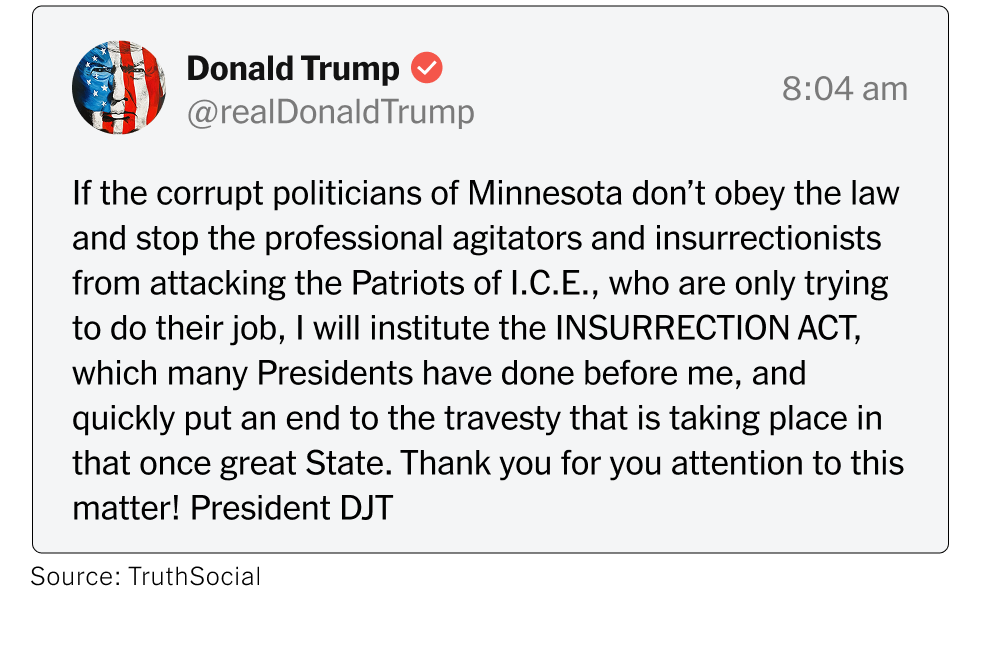
At 8:04 am (ET) Trump posted @realDonaldTrump:
Overnight an I.C.E. thug shot a person in the leg who fled from a “targeted traffic stop.” The agent followed and caught up with the individual. A DHS spokesperson claimed two people came out of a nearby building and “violently assault[ed] the officer” who responded by firing “shots” and striking the individual in the leg. Both were transported to the hospital and the condition of the thug was not known. In response to the shooting, protesters gathered near the shooting site and yelled, threw snowballs and shot off some fireworks at the I.C.E. agents. Importantly, reporters have been unable to confirm the veracity of the DHS claims.
Trump’s post, while typical with his use of ALL CAPS and in need of a professional editor, accuses “the corrupt politicians of Minnesota” of being unable to “stop the professional agitators and insurrectionists” from interfering with I.C.E. who were just “trying to do their job.” This appears to be his raison d’etre for threatening to invoke the Insurrection Act (“Act”). In the near future, there will be a lot of talk and posts about the Act. So I thought it worthwhile to provide a quick guide to the Act.1
The Act authorizes the president to deploy military forces inside the United States to suppress rebellion or domestic violence or to enforce the law in certain situations. The Act was first authorized in 1792 by Congress pursuant to the Constitution in Article 1, Section 8, Clause 15: "To provide for calling forth the Militia to execute the Laws of the Union, suppress Insurrections, and repel Invasions"
Keep in mind the Act is an exception to the Posse Comitatus Act which forbids U.S. military troops or federalized National Guards from civilian law enforcement. As the exception to this rule, the Act allows the U.S. military to assist civilian authorities with law enforcement. According to the Brennan Center for Justice, the problem with the Act is it “fails to adequately define or limit when it may be used and instead gives the president significant power to decide when and where to deploy U.S. military forces domestically.”2 This is especially dangerous now in the hands of Trump and Stephen Miller who have literally been gunning for the circumstances to lock and load.
On its face, there are four ways under the Act a president can call out federal military troops to assist civilian authorities.
One, the most relied on reason, is when civil authorities -a state legislature or governor - request and consent to federal military assistance. The Act was last invoked relying on this reason in 1992 when then California Governor, Pete Wilson, asked President George H.W. Bush for federal troops to quell the Rodney King3 Riots in Los Angeles. The civil unrest and violence resulted in 63 persons killed4 and hundreds injured, along with over a billion dollars in property damage. At the time, the LAPD was “almost an occupying force, particularly biased against people of color,” said lawyer and civil rights activist Connie Rice in an interview with NPR. In response to the unrest, the LAPD did not respond at all, or adequately, letting the riots go unabated for days.5 However, unlike the LA riots, Governor Walz or Minneapolis Mayor Frey will not request federal troops to suppress protesters from throwing snowballs or firecrackers.
A second reason to invoke the Act is without a request or consent of a state to “enforce the laws” of the United States or to “suppress rebellion” against the U.S. government whenever “unlawful obstructions, combinations, or assemblages, or rebellion” make it “impracticable” to enforce federal law in that state by the “ordinary course of judicial proceedings.” There is no evidence yet that local police and courts in Minneapolis cannot enforce laws that may be broken by protesters. This, again, is different than 1992 where the LAPD was a prominent cause of the riots and the damage inflicted. The police in LA made it impossible to stop the unrest without the assistance of federal troops.
The third reason allows the president to invoke the Act to suppress “any insurrection, domestic violence, unlawful combination, or conspiracy” that “so hinders the execution of the laws” that any portion of the state’s inhabitants are deprived of a constitutional right and state authorities are unable or unwilling to protect that right.6 Think of the constitutional rights deprived to southern Blacks that Presidents Kennedy and Johnson relied on as the reason to use federal troops to enforce school integration in the south after Brown v. Board. This reason will not likely be asserted by Trump as the only constitutional rights deprived are those of the largely peaceful protesters and I.C.E. targets who are deprived of their many constitutional rights, including due process, free speech and assembly, equal protection, unlawful search and seizure, among others.
The final reason under the Act allows a president to call out the troops to suppress “any insurrection, domestic violence, unlawful combination, or conspiracy” in a state that “opposes or obstructs the execution of the laws of the United States or impedes the course of justice under those laws.” If Trump and Miller need or want to justify invoking the Act, they will most likely rely on this clause. However, like the Act in its undefined totality, this ambiguous clause will allow Trump and his massive and mendacious propaganda machine to easily and unilaterally decide and define an alternative reality of what constitutes insurrection and violence. In other words, insurrection, domestic violence and the other predicate acts are what Trump says they are. Snowballs, anyone? We’re being told not to believe our lying eyes.
All of this is important because for whatever reason Trump relies on to invoke the Act, or no asserted reason at all, the courts for the most part cannot review a president’s decision to call up the troops. And even if a federal court found reason to second guess a president; ie. bad faith or obvious mistake, this Supreme Court would allow Trump’s decision to stand.
So what can we do in the face of the barbaric conduct committed by I.C.E. agents?
We must stay disciplined and not take the bait that I.C.E. throws out. Protests must remain nonviolent.
We must continue to show up and document for the whole world to see the violent and illegal use of excessive force, and so that the storm troopers will eventually be held accountable.
We must prevail on our elected leaders to demand nothing less than the complete shutdown of I.C.E. This is not the time for “reforms” around the edges. And if need be, shutdown the government over defunding I.C.E. Poll numbers suggest, like the Obamacare subsidies, this could be a strong hand. But this time the Democrats (I’m looking at you, Senator Schumer) must not blink.
And our politicians and others must stop thinking and saying that I.C.E. as it exists today can be fixed with better vetting and training. These hooligans have been hired from the scum of the scum and told to be as aggressive and fatally violent as they can be and there will be no consequences. DOJ Deputy Attorney General, Todd Blanche, one of Trump’s personal attorneys before the 2024 election, has already declared there is no basis to even open an investigation into Good’s killing. Like everything else, the Administration will bury any investigation and focus, instead, on Good and her wife.
Finally, Minnesota officials must open an investigation and prosecute Jonathan Ross if the evidence supports an indictment. The state has the right and obligation to enforce Minnesota’s criminal laws.
Whether it’s Minneapolis, Chicago, Portland, LA, Charlotte, Memphis or New Orleans, we didn’t start this fire. But we can fight it. If we do nothing, then I’m afraid we’re on the Eve of Destruction.7
For a more detailed explanation, check out The Insurrection Act, Explained, posted on November 12, 2025 by the Brennan Center for Justice. https://www.brennancenter.org/our-work/research-reports/insurrection-act-explained.
Id.
In 1991 King was brutally beaten by four LAPD officers. Despite the unmistakable videotape of the beatings to support an excessive force verdict, four officers were tried and acquitted in 1992 which set off the riots.
Nine persons were shot and killed by police, and one by the National Guard.
https://www.npr.org/2017/04/26/524744989/when-la-erupted-in-anger-a-look-back-at-the-rodney-king riots#:~:text=During%20the%20five%20days%20of,LAPD%20officers%20and%20National%20Guardsmen.
The Insurrection Act, Explained.
Apologies for mixing Billy Joel’s We Didn’t Start the Fire with the great Barry McGuire’s Eve of Destruction. Despite their age, they made perfect sense together in my mind as the soundtrack to this Substack. You’re free to disagree. Enjoy.