
Nuremberg or Bust?
Not So Fast

Recently there have been a growing number of posts on social media calling for Nuremberg-like trials. This photo, reposted on Jonathan Last’s Substack from The Bulwark titled This Photo Shows the Way Forward, is one of my favorites.
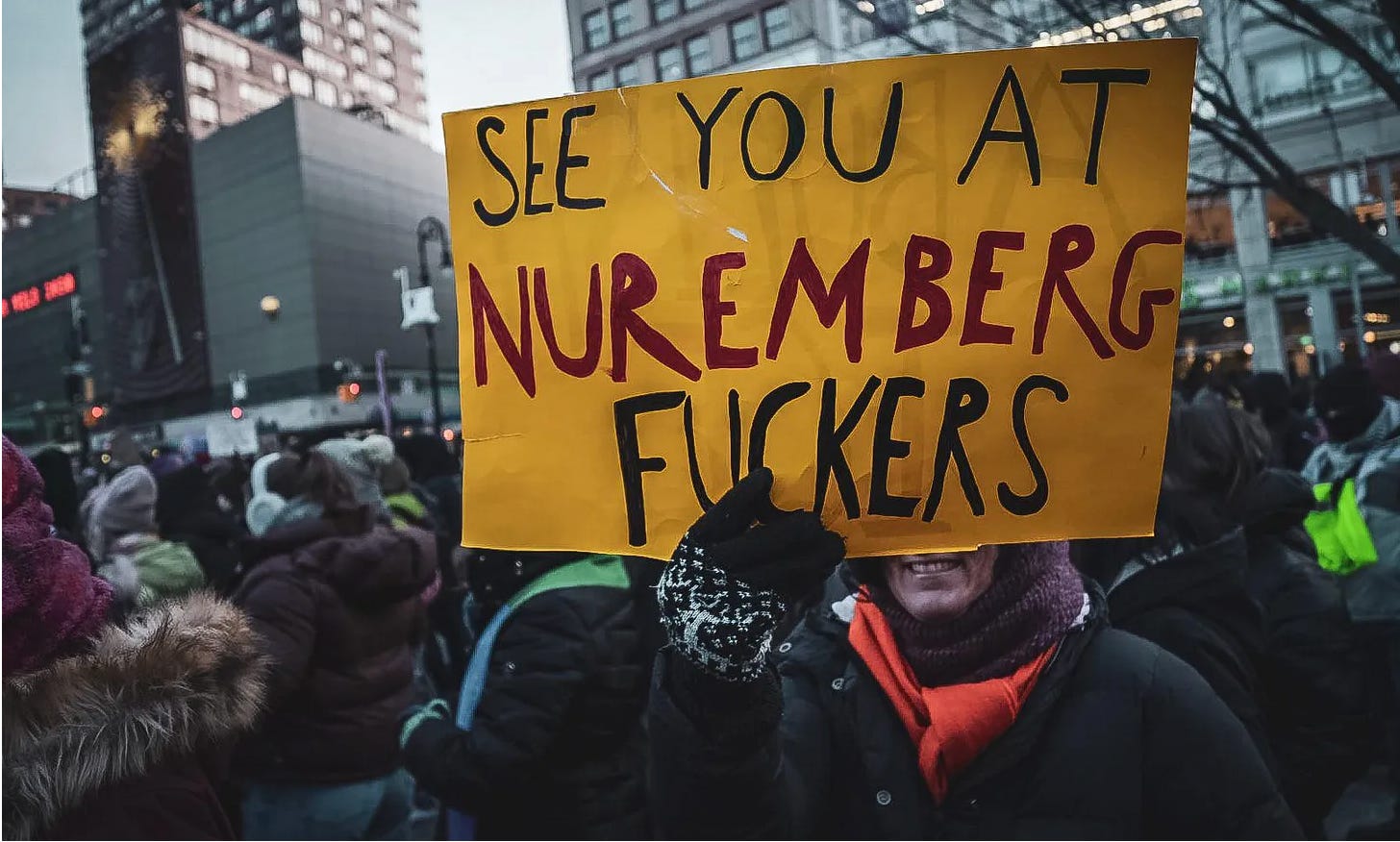
Last, who I follow, wrote on the heels of the mini-fascist Bovino’s early retirement:
And if, at some point in the future, the opposition takes power at the federal level, then it should seek legal accountability for the government officials who ordered, organized, and then covered up for these crimes.
We will need an American Nuremberg.1
In my darkest moments amid the rising anger I wouldn’t even give these bastards a trial of any kind. Just round them up and give Trump, Miller, Noem and the rest of the criminals a taste of their own relegation. Somalia would be my fevered destination dream. In more lucid moments the calls for Nuremberg-like trials, while momentarily cathartic, seem good for social media clicks and not for thoughtful planning about what comes next assuming “the opposition takes power at the federal level.”
Still, the pressure is building on the Trump cartel especially after the Alex Pretti execution. The knives are out. Noem might already be fine tuning her defense for when she’s standing in a glass-walled dock. Feeling the heat, Noem reportedly told Axios, “Everything I’ve done, I’ve done at the direction of the president and Stephen [Miller].” 2 Just following orders didn’t work at Nuremberg and won’t pass the smell test today. Or maybe they just reshuffle the deck so Susan Collins is no longer concerned and Chuck Schumer agrees to continue funding DHS and all is forgotten, at least until the next outrage.
Feeling somewhat optimistic, history has shown that most bad governments eventually go away for many different reasons. Popular uprisings. Revolutions. Coups. The death of a strongman or king. External forces. Etc. And I believe Trump and MAGA will implode, but not before more people will die. (My optimism has its limits.) But when it happens we must be prepared for the aftermath. And at least two things will have to happen.
First, there will have to be a new order of government. Obviously, our current form of a constitutional democracy is not working very well. And has not worked well for much of our 250 year history. The Founding Fathers understood this when they made all sorts of compromises during the summer of 1787 in Philadelphia. They knew the Constitution drafted would have to be amended instead of being treated today as biblical authority encased in a vault that can survive a 50-ton explosion. What a new government and constitution may look like will be the subject of a future Substack. In the meantime, please read Jill Lepore’s great history, We The People: A History of the U.S. Constitution.3
The second thing to happen brings me back to the calls for Nuremberg-like trials. What does that even mean today? The Nuremberg trials were international criminal trials conducted by the United States, Soviet Union, United Kingdom and France. The trials were the product of months long negotiations among the allies on exactly how the trials would occur and importantly what would be the charges and penalties made against the Nazis leaders and their complicit subordinates. Despite the horrors unleashed by Nazi Germany, there was not unanimity at the beginning due in part to the failure of a war crimes commission after World War I. This time they had to get it right. It was no easy task. That said, first there had to be agreement on the need for accountability.
Will there be such agreement among the warring factions in the United States, even among those who seem concerned and upset about the conduct of DHS and ICE? I’m not so sure. Still, history has numerous examples of new-order attempts at dealing with past traumas inflicted on a nation state. These can be somewhat conveniently categorized as accountability or reconciliation projects, the former more violent and punitive and the latter more focused on reintegration and the avoidance of recriminations.
The French Revolution produced the bloody Reign of Terror which killed more than 16,000 French. The Committee of Public Safety charged with protecting the new Republic from enemies foreign and domestic make ICE by comparison seem like a walk in the park. But maybe ICE is just getting warmed up. In the end, the bloody accountability in France led to a backlash and years of war and a partial restoration of the Ancien Regime.
With the American Revolution, there was a hybrid approach where Loyalists, those Americans who remained loyal to the King, a/k/a Losers, were punished by property confiscation and other punitive state laws. Nearly 60,000 Loyalists left America for England and Canada. Thousands others remained and were eventually integrated by new loyalty oaths and the passage of time.
Germany after WWII may be the best example of reconciliation. In Other Nations Could Learn From Germany’s Efforts to Reconcile After WWII the author wrote4:
Germany realized that if it were to rejoin the international community, it could not run from its crimes but had to confront them. But reconciliation and atonement were not immediately embraced, says Hanns Maull, one of Germany's leading academic foreign policy analysts and an adjunct professor of strategic studies at SAIS Europe. At the end of the war, a form of "collective trauma" initially fell upon the German citizenry, Maull says. "There was a sense of catastrophe—physical and material. Germany was destroyed. Partitioned. And then there was this moral catastrophe. German society had to face and recognize what had just happened. But this rather quickly subsided and people had to deal with their daily lives. So this trauma and feeling of guilt was suppressed." What people see today as Germany's success in coping with its past really started in the late 1950s and took hold in the 1960s, he says. The catalytic event was the Frankfurt Auschwitz trials that took place from 1963 to 1965. These were the first major Nazi war crime cases pursued not by the victorious Allies but by the Germans. People who had served at the concentration camp were brought to justice. But even then, many Germans cast blame on the destroyed Third Reich, as if that were somehow separate from Germany.
While Germany reconciled internally and with Europe, its biggest challenge was with Israel. This “special relationship” with Israel included reparations for the crimes of the Holocaust and significant investments in Israel’s growing economy. To this day, there are many Jews and Israelis who consider this blood money.
Today in Berlin you can visit the many museums about the crimes committed by the Nazi regime and later the Stasi police. There is no whitewashing and the perpetrators are branded for all the world as criminals. In contrast, Germany’s Axis partner Japan has not yet, in the opinion of many, made adequate efforts at reconciliation with the countries and peoples it went to war against in WWII.5 Rising right politics in Germany is threatening accountability and reconciliation, but for now the middle is holding.
South Africa had a restorative justice process to investigate and bring to light the crimes committed under apartheid rule. Led by Archbishop Desmond Tutu, the Truth and Reconciliation Commission gave individuals amnesty for their crimes in exchange for confessions and allowing victims to testify and bear witness.
Acceptance of the principle of amnesty for politically motivated crimes under apartheid was probably a worthy sacrifice and a necessary path taken by the ANC leadership in pursuit of national unity and peace during the difficult political transformation. Reconciliation in place of social justice certainly did not serve the interests of those South Africans who had endured decades of institutional racism, but reconciliation appeared to provide the best option for a peaceful transition that preempted the potential for explosive retributive bloodshed.6
South American countries, Argentina, Peru, Colombia and Chile, have all used truth telling commissions as a means to achieve national reconciliation after years of violent and repressive juntas where thousands of persons disappeared, were murdered and tortured.
Finally, since 2015 Canada has been engaged in active reconciliation with its Indigenous Peoples after years of colonialism and mistreatment by successive Canadian governments. Official government policy has identified 94 Calls to Action to achieve national reconciliation. There is even a government scoreboard that monitors how many of the 94 actions have been achieved. As of the end of 2025, the government reported 85 percent of the Calls to Action have been completed or are underway.7
From this brief survey it is undeniably possible for a country to achieve some sort of national unity around accountability, acknowledgment and reconciliation. However, under the Trump regime this time around the exact opposite has occurred. Our national museums, parks and government websites, for example, have purged, whitewashed and sanitized any attempt at remembering America’s difficult history. One of Trump’s earliest Executive Orders, Restoring Truth and Sanity to American History, declared the following as its purpose:
Over the past decade, Americans have witnessed a concerted and widespread effort to rewrite our Nation’s history, replacing objective facts with a distorted narrative driven by ideology rather than truth. This revisionist movement seeks to undermine the remarkable achievements of the United States by casting its founding principles and historical milestones in a negative light. Under this historical revision, our Nation’s unparalleled legacy of advancing liberty, individual rights, and human happiness is reconstructed as inherently racist, sexist, oppressive, or otherwise irredeemably flawed. Rather than fostering unity and a deeper understanding of our shared past, the widespread effort to rewrite history deepens societal divides and fosters a sense of national shame, disregarding the progress America has made and the ideals that continue to inspire millions around the globe.8
Whether acknowledging at Independence Hall in Philadelphia George Washington’s ownership of slaves as being inconsistent with the ideals of freedom and liberty, or how California Redwoods can help store carbon dioxide and slow climate change, Trump’s EO seeks to erase and rewrite American history.9 Given all what he has wrought, and is part of America’s genetic makeup, can we really expect and hope for long overdue accountability and reconciliation if and when we survive the current authoritarian regime dedicated to reconstituting the United States of America as a white, Christian nation.
The most meaningful historical example of what not to do in the United States after the current regime is toppled is America after the Civil War. Confederate soldiers laid down their arms and went home, while a handful of high ranking leaders, Jefferson Davis most prominently, were arrested for treason. He was never tried for political and legal reasons; politically fearing the fallout from a Richmond jury acquitting him of treason. Henry Wirz, the Commandant of the notorious Andersonville prison, was executed for war crimes. Reconstruction followed and former Confederate states had to be readmitted based on certain conditions including ratifying the Reconstruction Amendments (Amendments 13-15). Reconstruction eventually failed, and the Lost Cause and the rise of the KKK (MAGA’s predecessor) put us on a track to today. In the end, America did not have any accountability or reconciliation as Lincoln and later others were just glad the war ended and we would all live to fight another day, and the unfinished war rages on today.
We are still fighting the fights of the Founding Fathers, the Civil War, Reconstruction, Jim Crow, and for real equality for We the People. If our democracy somehow survives Trump and the MAGA fascists, what will we do as a nation to repair and amend our rights that have been so badly trampled or never realized in the first place? For me, that is the question of the moment. We have so much work to do before we ever get to Nuremberg.

https://www.axios.com/2026/01/27/trump-stephen-miller-massacre-minnesota-shooting.
https://jlepore.scholars.harvard.edu/publications/we-people-history-us-constitution.
https://hub.jhu.edu/magazine/2015/summer/germany-japan-reconciliation/.
Id.
https://www.ebsco.com/research-starters/history/south-africa-establishes-truth-and-reconciliation-commission.
https://www.rcaanc-cirnac.gc.ca/eng/1524494530110/1557511412801.
https://www.whitehouse.gov/presidential-actions/2025/03/restoring-truth-and-sanity-to-american-history/.
https://www.nytimes.com/2026/01/23/climate/national-park-service-deleting-american-history-slavery.html.